Why a GLP-1 may not get you long-term weight loss (And What Will)
If you’re reading this, there’s a good chance you’re already on a GLP-1 medication (Ozempic, Wegovy, Zepbound, Mounjaro) or you’re seriously considering one. Maybe your appetite has finally quieted down for the first time in years. Maybe the number on the scale is finally moving. That’s a big deal, and it’s worth celebrating.
But if you’ve spent any time in Facebook groups, Reddit threads, or late-night Googling, you’ve probably also come across the other side of the story: the muscle loss, the plateaus, the “Ozempic face,” the fear of what happens when you eventually come off the medication. You might be asking yourself a very reasonable question: is this weight loss actually going to last, or am I just renting it?
That question is exactly why we’re writing this. At Vital Body, we work with people every day who are using GLP-1 medications to lose weight, and what we’ve found (both in the research and in the mirror, on the scale, and in how our clients feel) is that the medication works best as part of a bigger plan. It quiets your appetite, but it doesn’t replace good nutrition, it doesn’t protect your muscle, and it doesn’t build the habits that make results last. That’s where 1:1 coaching comes in, and it’s the piece almost nobody talks about when they talk about GLP-1s.
What GLP-1s Actually Do (And Why They’re a Big Deal)
GLP-1 (short for glucagon-like peptide-1) is a hormone your gut naturally releases when you eat. Medications like semaglutide (Ozempic, Wegovy) and tirzepatide (Mounjaro, Zepbound) mimic that hormone and keep it active in your body far longer than it would naturally stick around. The result: your blood sugar stabilizes, you feel full faster and stay full longer, and that constant mental hum of “what am I going to eat next” (often called “food noise”) finally quiets down.
For a lot of people, this is genuinely life-changing. Clinical research shows people using these medications can lose somewhere between 5 and 15% of their total body weight over about a year. The benefits don’t stop at weight loss, either. Studies have also linked GLP-1s to improvements in cardiovascular health, sleep apnea, liver health, and even some cognitive markers. It’s easy to see why these medications have been called a game-changer for obesity treatment.
But here’s the part that matters just as much: a GLP-1 quiets your appetite. It doesn’t teach you how to eat. It doesn’t build a workout habit. And it doesn’t protect your muscle. Those things are still entirely up to you, and that’s exactly where most people run into trouble.
The Part of the GLP-1 Story Nobody Warns You About
You can lose a lot of muscle, not just fat
This is the one that surprises people the most. When you lose weight quickly, on any method including GLP-1s, your body doesn’t pull only from fat stores. Some research suggests that muscle can account for as much as 40 to 60% of the total weight lost while on a GLP-1. That’s a striking number when you consider that under normal, slower weight loss, roughly a quarter of what you lose tends to be lean mass.
Why does this matter so much? Muscle is what keeps your metabolism running. Lose too much of it, and your resting metabolic rate drops, insulin resistance can actually get worse, and especially past your 40s and 50s, you become more prone to frailty, injury, and the kind of slow physical decline nobody wants to sign up for. In other words: losing “weight” isn’t the same as losing “fat,” and the difference matters for the rest of your life, not just for how your jeans fit next month.
Weight regain after stopping is common
Here’s another uncomfortable truth: research following people after they stop taking semaglutide found that, on average, they regained about two-thirds of the weight they’d lost within a year. That’s not a knock on the medication. It’s just biology. If nothing has changed about how you eat, move, and think about food, your body tends to find its way back to where it started once the appetite-suppressing effect goes away.
A lot of people stop taking them altogether
Cost is a real barrier. GLP-1s can run well over $900 a month without insurance coverage, and more than half of adults taking them report it’s been difficult to afford. Side effects are another factor. Nausea, constipation, and other GI symptoms are common, especially early on, and they’re one of the leading reasons people discontinue treatment. One industry analysis found that roughly 30% of people prescribed a GLP-1 stop taking it within the first 30 days.
None of this is meant to scare you off GLP-1s. For the right person, they’re a legitimately powerful tool. But it should reframe how you think about them: not as the finish line, but as one part of a bigger plan. And that bigger plan is exactly where the right coaching and nutrition support changes the whole trajectory.
One pattern we see all the time: a client starts a GLP-1, sees great early results, and then things stall. It’s rarely the same fix twice. Sometimes it means a conversation with the prescriber about the dose or the specific medication. Sometimes it’s connected to what they’re eating, or not eating. One client of ours just needed to increase her hydration, and within days, things started moving again. That’s the value of having a real person looking at your whole picture instead of guessing. It’s what we love most about coaching at Vital Body.
Why What You Eat Still Determines the Outcome
Think about what a GLP-1 is actually doing: lowering your appetite and slowing digestion. Now think about what happens to someone eating less food overall, without paying close attention to what that food is made of. It’s incredibly easy to end up under-eating protein, missing key vitamins and minerals, and inadvertently starving your muscle right alongside your fat.
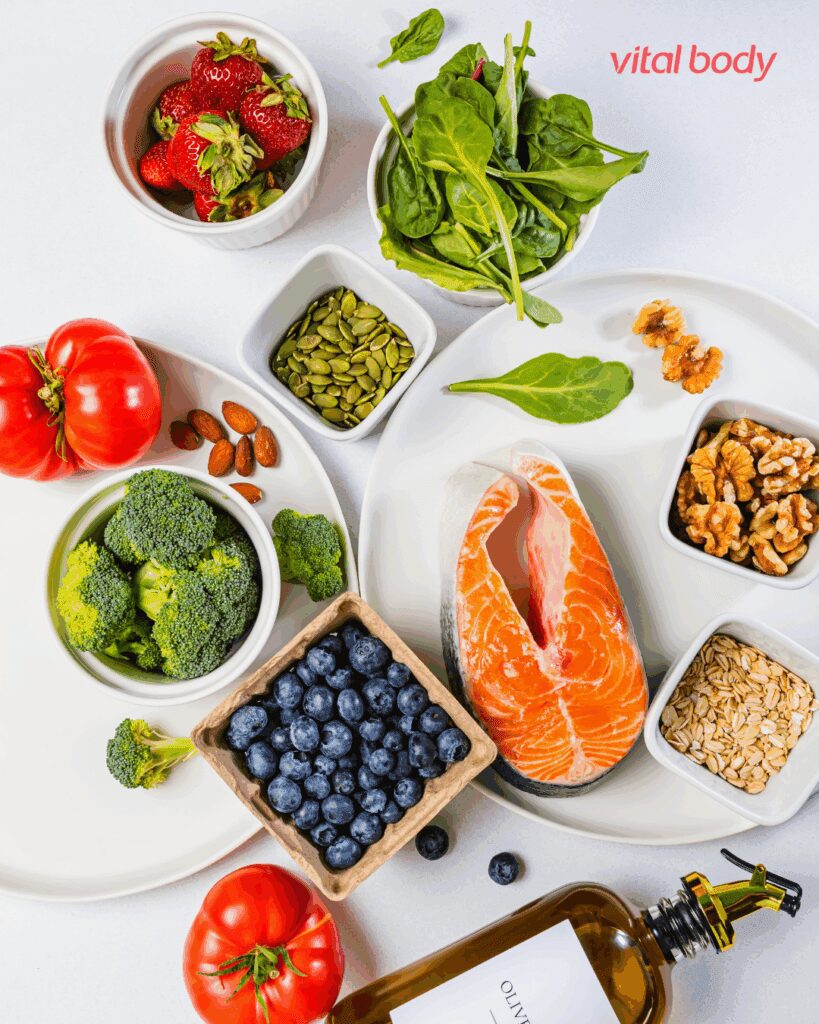
This is where a protein-forward approach earns its keep. Protein does three things that matter enormously for someone on a GLP-1:
– It keeps you fuller, longer. Of the three macronutrients, protein is the most satiating, which pairs naturally with what the medication is already trying to do. – It burns more calories just to digest. Protein has a higher “thermic effect” than carbs or fat, meaning your body works harder to break it down, burning more energy in the process. – It protects your muscle. When you’re in a calorie deficit, your body needs adequate protein as raw material to preserve lean tissue instead of cannibalizing it for energy.
There’s real data behind this, too. In one internal analysis, clients following a structured, protein-forward protocol for 16 weeks lost significant fat (an average of 25% of fat mass in men and 24% in women) while preserving the vast majority of their lean muscle (98% in men, 95% in women). That’s the opposite of the muscle-loss pattern researchers are flagging with GLP-1s used on their own. Pairing the appetite control of a GLP-1 with a nutrition structure built specifically to protect muscle isn’t just complementary. It’s arguably the smartest way to use these medications at all.
There’s a hydration and micronutrient piece too, one that’s easy to overlook. Eating less overall means it’s easier to fall short on fluids, electrolytes, fiber, and key vitamins, which is part of why side effects like constipation, fatigue, and headaches show up. A good nutrition plan isn’t just about protein; it’s about making sure your body has what it needs to function well while you’re losing weight quickly.
Why 1:1 Coaching Is the Piece That Actually Makes This Work
Here’s something that’s easy to underestimate until you’ve lived it: knowing what to do and actually doing it, consistently, for months, while your body and your medication dose are both changing are two very different things.
This is where an app or a generic meal plan runs out of road. GLP-1 side effects don’t show up on a schedule: the nausea that hits during dose escalation, the constipation that lingers for weeks, the days you genuinely don’t feel like eating at all. Figuring out how to navigate those moments (when to space meals differently, what to eat when nothing sounds appealing, when something is actually worth calling your doctor about) takes a real person who knows your history, checks in with you, and adjusts the plan with you in real time. Not a static PDF. Not a chatbot. A coach.
That’s the entire premise behind how we work at Vital Body. Every client gets one-on-one support: not a cohort, not a forum, a person who is tracking your progress, anticipating the bumps that are coming with your specific GLP-1 and your specific dose, and adjusting your plan as your body changes. When you’re nauseous in week three, we already know the meal-spacing tricks that help. When you hit a plateau in month four, we know whether that’s normal, whether your protein intake needs adjusting, or whether it’s time for a conversation with your prescriber. When you’re ready to think about maintenance, whether you’re staying on the medication long-term or planning to taper off, we’re the ones building the muscle-preserving, metabolism-protecting foundation that determines whether your results last or slip away.
At Vital Body, that day-to-day relationship is the whole point. We get to know each client, not just their weight or their meal plan, but their patterns, their stress, their wins and their setbacks. Getting healthy and building real lifestyle change is a slow and steady wins the race kind of process. Plenty of clients love the fast results that come with extreme measures, and for a while that feels great. But there comes a point where the smarter move is to slow down, look at the bigger picture, and focus on what will actually work long term. That’s a conversation an app can’t have with you. A coach can.
This is also, honestly, the piece that most GLP-1 prescriptions are missing entirely. Doctors are stretched thin. A 15-minute follow-up appointment every few months isn’t enough time to troubleshoot your relationship with food, catch early warning signs of muscle loss, or keep you accountable to habits that will outlast the prescription. Emerging research is starting to back this up directly: coaching alongside GLP-1 treatment is associated with better outcomes and better safety monitoring, precisely because someone is actually paying attention between appointments.
Do I Have to Choose Between Ozempic and Vital Body? (No, Here’s How They Work Together)
One of the most common questions we get is whether this is an either/or decision: Ozempic, Wegovy, or Mounjaro on one side, or a coaching program like ours on the other. It’s not. Our core program, Phase 1, is built to work right alongside a GLP-1 medication, not compete with it.
The protocol itself doesn’t change. It’s still the same doctor-designed approach built to protect muscle while you’re in a calorie deficit. What changes is how we coach you through it. Appetite suppression from a GLP-1 changes how, when, and how much you’re able to eat, and that shifts how we manage meal timing and protein intake. Side effects like nausea or GI symptoms need to be handled differently too. Our team has gone through dedicated training and certification specifically on working with clients using GLP-1 medications, covering both the side effects and the real benefits, so you’re not the first client we’re figuring this out with.
If you’re already on a GLP-1 and wondering whether coaching makes sense on top of it, or you haven’t started one yet and want a plan that would work either way, that’s exactly the conversation worth having with us before you decide.
What This Looks Like in Practice
At Vital Body, clients on GLP-1s typically start with a structured, protein-first phase designed to do two things at once: maximize fat loss and protect the muscle you already have. This isn’t guesswork. It’s a deliberate response to what the research shows about how these medications affect the body, paired with hands-on coaching that adjusts to how you’re actually feeling week to week.
From there, the work shifts. As your dose changes, as side effects come and go, as life happens, your coach is adjusting alongside you, not handing you a plan on day one and disappearing. And when you reach a goal weight, the conversation doesn’t end there either. Whether you decide to stay on your GLP-1 long-term or start tapering off with your doctor’s guidance, the habits, the muscle, and the coaching relationship you’ve built are what carry you into the next phase: the one where the real goal lives, not just losing weight, but keeping it off, staying strong, and feeling like yourself again for good.
Jamie is a good example. She came to us frustrated, feeling like nothing was working fast enough. When we sat down together, what became clear was that her focus had been entirely on weight loss, not on making herself and her health a priority. That one subtle shift, giving herself some space and some kindness instead of constant pressure, changed how she approached everything else that followed.
A Quick, Honest Note
We’re not doctors, and this isn’t medical advice. Your prescriber is always the right person to talk to about your medication, your dose, or any symptom that feels serious or unusual. What we are is the piece of the puzzle that’s there every day in between appointments: helping you eat in a way that protects your muscle, manage side effects with practical strategies, and build the habits that will still be working for you long after any medication conversation is finished.
If You’re Already on a GLP-1 (Or Thinking About It)
If you’re already taking a GLP-1 and wondering why the scale has stalled, or you’re worried about what happens when the medication effect starts to lessen or you eventually come off it, that’s a conversation worth having, and it’s exactly what we do. And if you haven’t started a GLP-1 yet but you’re weighing your options, it’s worth knowing that pairing one with real nutritional coaching from the start puts you in a completely different position than starting the medication alone and hoping for the best.
Either way, the goal isn’t just a lower number on the scale next month. It’s building a body and a set of habits that will still be serving you five, ten, twenty years from now. That takes more than a prescription. It takes a plan, and it takes someone walking through it with you.
If that’s what you’re looking for, we’d love to talk. Reach out to Vital Body and let’s figure out what your plan should look like. Book a Free Consultation. We look forward to meeting you.
Zan & Em